
The Yoga Sutras & Bhakti Sutras in Light of Personal and Impersonal Bhakti
May 2026 | The Yoga Sutras & Bhakti Sutras in Light of Personal and Impersonal Bhakti
No one can say with finality that God is only ‘this’ and nothing else. He is formless, and again He has forms. For the bhakta He assumes forms. But He is formless for the jnani, that is, for him who looks on the world as a mere dream. The bhakta feels that he is one entity and the world another. Therefore God, reveals Himself to him as a Person. But the jnani — the Vedantist, for instance — always reasons, applying the process of ‘Not this, not this’. Through this discrimination he realises, by his inner perception, that the ego and the universe are both illusory, like a dream. Then the jnani realises Brahman in his own consciousness. He cannot describe what Brahman is.
The Gospel of Sri Ramakrishna
Volume I, Chapter - 6 October 28, 1882
Class 1: The Foundations of The Yoga Sutras (Raja Yoga) & The Bhakti Sutras
Class Topic: By exploring the first the sutras in the Yoga Sutras and Bhakti Sutras we aim to understanding the starting point of Raja Yoga and Bhakti Yoga in the context of sutra study and names used to denote God or the Divine.
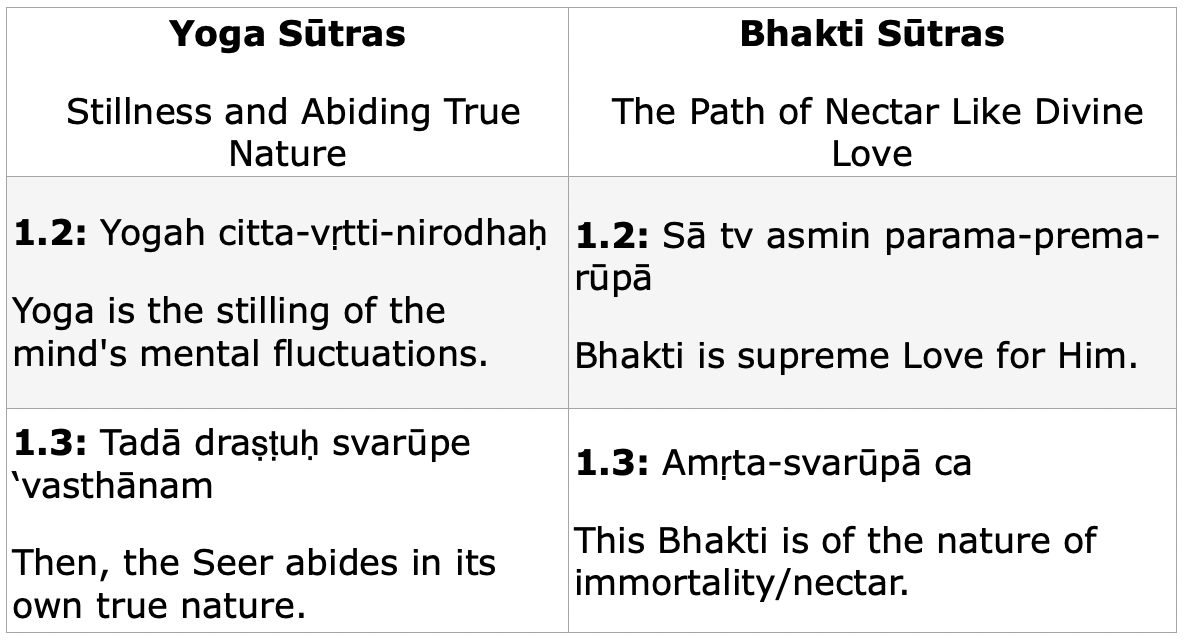
Yoga Sūtra
1.1 Atha yoga-anuśāsanam - Now in this auspicious present moment begins the teaching on Yoga
1.2 Yogah citta-vṛtti-nirodhaḥ - Yoga is the stilling of the fluctuations of the mind.
1.3 Tadā draṣṭuḥ svarūpe ‘vasthānam - Then the Seer abides in its own true nature.
Bhakti Sūtra
1.1 Atha bhakti vyākhyāsyāmaḥ. - Now in this auspicious present moment we shall explain devotion (bhakti).
1.2 Sā tv asmin parama-prema-rūpā. - Bhakti has been described as the supreme love towards Him (God).
1.3: Amṛta-svarūpā ca - This devotion is also of the nature of immortality/nectar.
Comparing the Opening Sutra in Bhakti Sutras and Yoga Sutras
Defining the Divine: Names for God
In the Yoga Sūtras: Puruṣa & Īśvara
In Raja Yoga, the Divine is approached as the Supreme Teacher or the Special Puruṣa.
Yoga Sūtra 1.24: kleśa-karma-vipāka-āśayair aparāmṛṣṭaḥ puruṣa-viśeṣa īśvaraḥ
Īśvara (God) is a Special Puruṣa (Cosmic Person/Being), untouched by afflictions, actions, their results, or latent impressions.
Yoga Sūtra 1.27: tasya vācakaḥ praṇavaḥ -
His designation is the sacred syllable Om (praṇava).
Puruṣa Prakṛti
The Yoga Sūtras are rooted in Sāṃkhya philosophy, which is dualistic perspective. Sāṃkhya divides reality into two separate categories:
- Puruṣa: Pure, individual consciousness (the "Seer").
- Prakṛti: Material nature, including the mind, body, and the all of manifest creation.
Yoga Sūtra 3.56: sattva-puruṣayoḥ śuddhi-sāmye kaivalyam iti
When the purity of the intellect (sattva) becomes equal to the purity of the Self (puruṣa), then Kaivalya (liberation/isolation) is attained.
Yoga Sūtra 4.34: puruṣārtha-śūnyānāṁ guṇānāṁ pratiprasavaḥ kaivalyaṁ svarūpa-pratiṣṭhā vā citi-śaktir iti
Kaivalya is the re-absorption of the guṇas (nature) which have no further purpose for the Puruṣa; or, it is the establishment of the power of pure consciousness in its own true nature."
Puruṣa and Prakṛti are often personified as Śiva Śakti, Sītā Rāma, or Rādhā Kṛṣṇa. While much can be said about gender and the Divine, these framings are believed by some schools to be Ultimately male/female while others believe these are pointers reflecting human experiences of common things seen in the natural world but Ultimately not relating to gender.
Yoga separates the Seer (puruṣa) from the Seen (prakṛti) while various schools of Bhakti hold different opinions on the Seer and the Seen and the nature of the divine couples play.
In the Bhakti Sūtras: bhagavān & asmin
Bhagavān - Supreme Lord:
Bhakti Sūtra 37: loke’pi bhagavad-guṇa-śravaṇa-kīrtanāt
In the world, [Bhakti is attained] also by hearing and chanting the divine qualities of Bhagavān.
Bhakti Sūtra 38: mukhyatas tu mahat-kṛpayaiva bhagavat-kṛpā-leśa-vādā
Mainly, however, Bhakti is attained through the grace of great souls, or through a little Divine Grace.
Bhakti Sūtra 79: sarvadā sarva-bhāvena niścintair bhagavān eva bhajanīyaḥ
God alone should always be worshipped with all one’s heart and without any worry. (translation from Edwin Bryant)
Asmin - Toward Him:
Bhakti Sūtra 2: ā tv asmin parama-prema-rūpā
Bhakti is supreme Love for the Divine.
Bhakti Sūtra 41: tasmims-taj-jane bhedābhāvāt
Because there is no difference between Him and His devotees.
Bhakti Sūtra 65: tad-arpitākhilācāraḥ san kāma-krodhābhimānādikaṃ tasminneva karaṇīyam
Having dedicated all actions to Him, one should direct even one's desire, anger, and pride only toward Him.
The Nārada Bhakti Sūtras are traditionally considered Vaiṣṇava tradition, the text makes use of a strategic linguistic approach which invites a more universal understanding of the text. In Sūtra 2 Nārada uses the phrase:
"Sā tv asmin parama-prema-rūpā,"
asmin means "in This" or "toward Him" which is not a specific name of God.
This grammatical choice acts as a "placeholder", allowing seekers of various backgrounds to project their own chosen deity (Ishta Devata) into their understanding of the Sutras
However, in various scholarly revision or editing of the text as well as commentaries, the term Bhagavān is used to anchor this love in a personal, relational context.
While asmin keeps the path accessible and universal, the presence of Bhagavān points specifically to the "Lord of Excellences", a term that, in the historical context of the Sūtras, denotes the personal God, Viṣṇu or Kṛṣṇa, or Rama. While the text is Vaiṣṇava using the word, "That" (asmin) invites a Universalist reading of the text. In our next class we will dive more deeply into the historical meaning and context of the rich and powerful word Bhagavān beyond Vaiṣṇava perspectives.
Contemplation:
In my spiritual life do I tend to seek inner infinite formless expansion beyond identity or a devotional relationship to a God with a specific name and form? Or maybe both?
How do these two approaches feel different in my heart, mind and body?
Yoga Maya Rising Non-Profit Mission
To love and serve all, for modern mystics with mission hearts
“Each soul is potentially divine. The goal is to manifest this Divinity within by controlling nature, external and internal. Do this either by work, or worship, or psychic control, or philosophy — by one, or more, or all of these — and be free. This is the whole of religion. Doctrines, or dogmas, or rituals, or books, or temples, or forms, are but secondary details.”
—The Complete Works of Swami Vivekananda, Vol 1, Preface to Raja-Yoga
Are you enjoying the blog? Stay connected with news and updates and get a FREE PDF GUIDE: 10-Facts Every Yoga Practitioner and Teacher Needs to Know!
This short guide lays out simply facts about the Yoga tradition you should have learned in Yoga Teacher Training but probably didn't. By singing up to get the Free PDF you are joining our mailing list to receive the latest news and updates from our team.
Don't worry, your information will not be shared and you can unsubscribe at any time
Are you enjoying the blog? Stay connected with news and updates and get a FREE PDF GUIDE: 10-Facts Every Yoga Practitioner and Teacher Needs to Know!
This short guide lays out simply facts about the Yoga tradition you should have learned in Yoga Teacher Training but probably didn't. By singing up to get the Free PDF you are joining our mailing list to receive the latest news and updates from our team.
Don't worry, your information will not be shared and you can unsubscribe at any time
Recent Posts

Categories
All Categories